
Polish Pad and Compound — Industry Guide & Why SYBON Is Your Best Supplier
Understanding the relationship between the polish pad and compound is essential for professional results in automotive paint correction, detailing, and surface restoration. This article explains the industry fundamentals — pad types, compound grades, machine compatibility, technique, and maintenance — and then introduces SYBON as a professional manufacturer and supplier of high-performance polishing compounds and polish pads. If you sell automotive care products, run a body shop, or operate a detailing business, this guide will help you select the correct materials and evaluate a supplier that balances quality, price, and service.
Industry fundamentals: What are polish pads and compounds?
A polish pad and compound work together to remove defects, refine paint texture, and restore gloss. The compound provides the abrasive action (in liquid or paste form) while the pad delivers controlled mechanical contact to abrade and level the surface. Proper pairing of pad and compound is crucial: mismatches cause inefficient cutting, swirl marks, or inadequate finish.
Types of polish pads
- Foam pads — Most common; available in varying cell structures and densities. Closed-cell foams often provide faster cut; open-cell foams yield a softer, more finish-oriented result. Foam pads are color-coded by many manufacturers to indicate cut/aggressiveness.
- Microfiber pads — Combine fabric and foam for strong cutting power with reduced heat buildup. Suitable for heavy defect removal with rotary or high-torque dual-action machines.
- Wool pads — Aggressive cutting pads used primarily for severe defects or heavy compounding. Wool can remove deep sanding marks quickly but requires careful control to avoid holograms.
- Finishing pads — Soft microfoam or ultra-soft wool blends designed to apply fine polish or glaze and produce a high-gloss finish with minimal defects.
Types of compounds and polishes
- Heavy-cut compounds — Coarse abrasives for removing deep scratches and sanding marks. Require aggressive pads and precise technique.
- Medium-cut polishes — Balance defect removal and finish refinement; often used as a second step in multi-stage correction.
- Finishing polishes — Ultra-fine abrasives or chemical polishes that refine clarity and enhance gloss.
- All-in-one products — Combine cutting and finishing properties for single-step correction on lightly damaged paint.
Matching pad and compound
Correct results come from matching aggressiveness levels:
- Use wool or heavy microfiber pads with heavy-cut compounds for sanding marks or deep scratches.
- Use medium-density foam with medium-cut polishes for moderate defects.
- Use soft finishing foam with finishing polish to remove minor haze and produce mirror-like gloss.
Always perform a small test spot to confirm compatibility. Consider the type of paint (single-stage, basecoat/clearcoat, ceramic-coated finishes) — modern clearcoats are thin and heat-sensitive, so conservative pad/compound combinations are safer.
Machines and technique
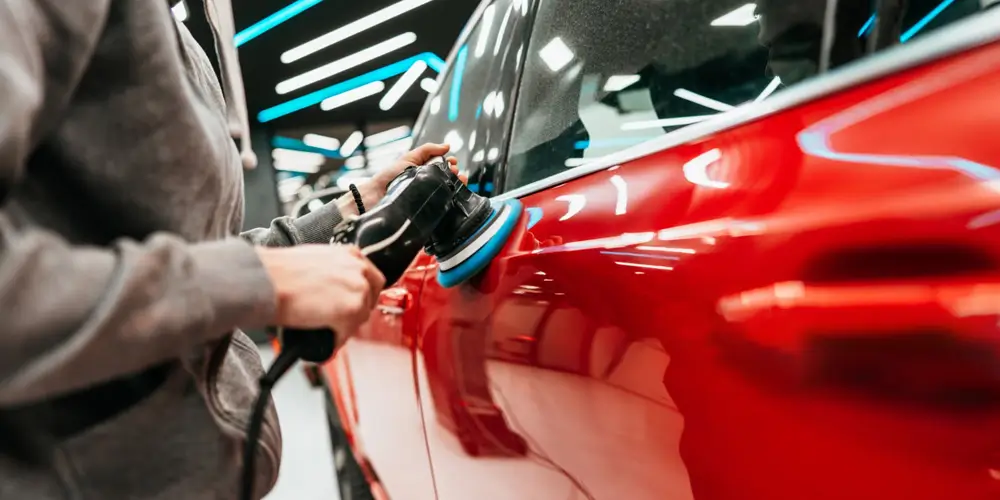
- Dual-action (DA) polishers are preferred for most detailing because they reduce risk of heat buildup and clearcoat burn while still delivering effective correction.
- Rotary polishers deliver higher cutting power but require experienced operators due to increased risk of holograms and clearcoat damage.
- Control speed, pressure, and dwell time. Excessive heat will degrade clearcoat and reduce polish performance.
- Use a cross-hatch pattern and finish passes to remove micro-marring.
Pad and compound maintenance
- Clean foam and microfiber pads after each session using a pad brush and warm water with mild detergent, or a dedicated pad cleaner.
- Replace pads once they are deformed, heavily contaminated, or no longer produce consistent results.
- Store compounds in cool, dry conditions and reseal lids to preserve chemical stability.
Safety and environmental considerations
- Work in a well-ventilated area; use respirators and gloves when required by product SDS.
- Dispose of polishing residues and contaminated wipes per local regulations — many compounds contain petrochemical carriers that are not suitable for drain disposal.
Practical tips for removing sanding marks
1. Start with the least aggressive pad/compound that achieves the desired correction in a test area.
2. If sanding marks persist, step up to a medium-cut polish with a medium-density pad before using a heavy-cut option.
3. Follow heavy cutting with a refinement step (medium polish + softer pad), then a finishing polish to eliminate holograms.
4. Finish with a sealant or wax to protect the corrected surface.
SYBON — Professional Polishing Compound Manufacturer and Supplier of Polish Pads
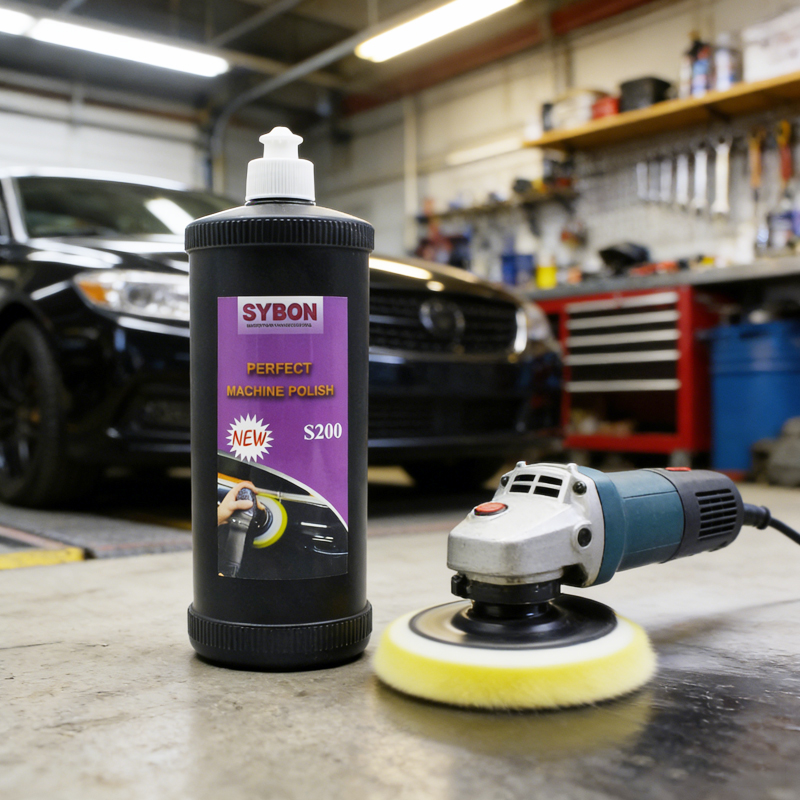
SYBON is a China-based, professional manufacturer specializing in polishing compound and polish pads, plus a full range of automotive care products. We produce high-performance polishing compounds and supply compatible pads suited for both professional detailers and automotive workshops.
Quality comparable to major brands, with superior value
SYBON’s products deliver performance comparable to well-known global brands while offering more competitive pricing and higher cost-efficiency for distributors and end users. Our manufacturing follows rigorous quality control processes to ensure consistent abrasive performance, stable rheology, and predictable finishing traits. For businesses that want top-level results without the premium price of legacy brands, SYBON provides a compelling value proposition.
Full product support for distributors and resellers
- Wholesale and low minimum order options — We support distributors, regional dealers, and shop owners with flexible wholesale terms.
- Product range — Heavy-cut compounds, medium polishes, finishing polishes, foam/microfiber/wool pads, and accessories.
- Technical guidance — We provide application guidance to help distributors and customers select the correct polish pad and compound pairings for various paint systems.
- After-sales service — SYBON commits to responsive customer support and warranty handling.
- Samples for testing — Prospective agents, paint shop owners, and distributors may request samples for local testing to validate product performance in their market.
Market opportunity
Although SYBON’s brand may not be as widely known as some large incumbents, our high product quality and cost-effective pricing make us an ideal partner for businesses aiming to gain local market share. SYBON products enable resellers to offer competitive pricing while maintaining professional results — a practical advantage for penetrating price-sensitive markets or expanding service offerings in established markets.
Call to action
SYBON is actively seeking global agents and distributors. If you are a distributor, detailing shop owner, paint shop manager, fleet operator, or repair center owner and wish to become a SYBON partner, request samples for testing and discuss cooperative terms. Please send an inquiry through our website contact form or email us via the site; our team will respond within 24 hours. Choose SYBON for high-quality polishing compounds, compatible polish pads, and a partner-oriented wholesale program that helps you grow your business profitably.
SYBON combines technical expertise in abrasives with practical commercial terms designed for distributors and detailing professionals. For proven results with a favorable margin structure, SYBON is the polishing compound and polish pad supplier to consider when you need professional performance without premium pricing.
Source of this article:https://www.sybonbest.com
Get to know us through more channels: