
How Is Polishing Compound Made — Industry Overview and Why SYBON Is Your Best Supply Partner
Polishing compounds are engineered materials designed to remove surface defects, refine finishes, and restore gloss on metals, paints, plastics, and other substrates. If you’ve ever asked “how is polishing compound made”, the short answer is: through carefully controlled selection and blending of abrasive particles, binders, lubricants, and performance additives, followed by precision processing and rigorous quality control. Below is a practical, industry-focused explanation of the manufacturing process, the performance considerations that matter to professional users, and why SYBON is a competitive supplier for wholesale buyers and distribution partners.
Raw materials and formulation principles
A polishing compound’s performance depends principally on three categories of inputs:
1. Abrasives — the cutting agents. Common abrasive materials include aluminum oxide, silicon carbide, chromium oxide, and iron oxide. Particle size distribution (from coarse to ultra-fine) determines cutting aggressiveness and finish quality. Consistent, tightly controlled particle-size distribution is essential for repeatable results.
2. Binders and carriers — these hold abrasive grains together and control how they are delivered to the surface. Binders may be oils, waxes, polymer emulsions, or combinations that balance spreadability, adhesion to polishing pads, and residue properties.
3. Additives — lubricants, anti-clog agents, stabilizers, wetting agents, corrosion inhibitors, and pigments. These additives tailor the compound’s behavior: minimize pad loading, improve cut control, protect the substrate, and adjust appearance (color and texture) for easy identification.
Formulators choose raw materials based on the target application (metal vs. paint vs. plastic), the required cut-to-finish balance, and regulatory or customer requirements (VOC limits, compatibility with paint systems, etc.).
Key manufacturing steps
The typical manufacturing sequence for a liquid, paste, or bar polishing compound includes:
1. Weighing and pre-blending — Raw materials are precisely weighed to recipe specifications. Abrasive batches are pre-blended when multiple grit fractions are used.
2. Dispersion and milling — Abrasive particles are dispersed into the binder system using high-shear mixers, ball mills, or bead mills. Milling is the step where particle agglomerates are broken down and the dispersion becomes uniform. Process variables (time, speed, media, temperature) directly affect product consistency and performance.
3. Homogenization and deaeration — After milling, the mix is homogenized and deaerated to remove entrained air and achieve the desired rheology (viscosity, thixotropy). This step improves shelf stability and ensures consistent dispensing.
4. Additive incorporation — Fine-tuning additives (lubricants, anti-loading agents, corrosion inhibitors, fragrances) are mixed in under controlled conditions to achieve balanced performance.
5. Quality control sampling and testing — Samples are tested for particle distribution, viscosity, pH, specific gravity, and performance attributes such as cutting rate and leaving/no residue after buffing. Many manufacturers conduct panel tests (on paint or metal substrates) to validate cut and gloss metrics against benchmark standards.
6. Filling and packaging — Compounds are packaged in tubes, jars, buckets, or bars depending on format. Packaging is chosen to maintain product integrity and to suit end-user needs.
Performance validation and regulatory compliance
Quality manufacturers perform both laboratory and field validation. Typical lab tests include abrasive particle size analysis, accelerated stability (temperature cycling), and rheology assessments. Performance validation often involves real-world panel testing to measure defect removal rates, surface gloss (measured with a gloss meter), and ease of polish removal.
Regulatory compliance is also a part of modern compound manufacturing: adherence to workplace safety standards, proper VOC management where applicable, and accurate material safety data sheets (MSDS/SDS) for customers.
Practical considerations for buyers
When evaluating polishing compounds, professional users and distributors should consider:
1.Cut vs. finish trade-off: Aggressive compounds remove defects faster but may require finer follow-up steps to produce gloss. Multi-step systems are common.
2.Pad compatibility: Formula should work with common foam, wool, or microfiber pads.
3.Residue and clean-up: Low-residue formulas reduce cleaning time and improve workflow.
4.Shelf life and stability: Longer shelf life reduces inventory losses.
5.Cost-per-outcome: Evaluate material cost relative to performance and throughput—not just unit price.
SYBON — Manufacturer profile and wholesale opportunity
SYBON is a professional polishing compound manufacturer based in China, specialized in high-performance automotive care products. We design, produce, and distribute polishing compounds that meet the needs of dealerships, body shops, fleet owners, repair shops, and detailers.
1.Comparable quality to major brands: SYBON products are formulated and manufactured to deliver cutting performance and finish quality comparable to well-known international brands. We apply rigorous production controls, particle-dispersion technology, and batch-level QC to ensure consistent results.
2.Cost efficiency and value: Where major brands command premium pricing, SYBON offers a highly competitive price-performance ratio. For distributors and agents seeking to enter or expand in local markets, our compounds provide a strong value proposition—professional-grade results at accessible wholesale pricing.
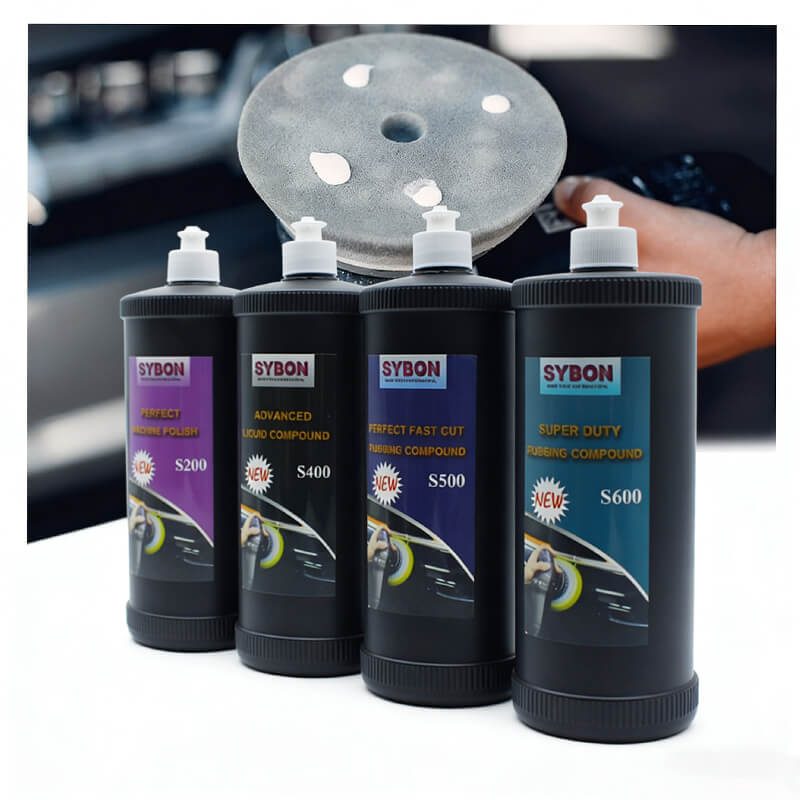
3.Comprehensive product range: We supply multi-step polishing systems (coarse compounding through fine finishing), specialty compounds for metal and plastic, and complementary automotive-care products to create bundled offers for customers.
4.Partner support and service: SYBON is actively recruiting global distributors and agents. We provide sample testing for potential partners, technical support, marketing materials, and training to help you introduce products to your market. While our brand recognition may be smaller than some global giants, our product performance, pricing, and customer service are structured to help distributors achieve competitive advantage and margin growth.
Call to action
If you are a dealer, paint shop owner, auto repair center manager, or distributor and you want a supplier that combines professional-quality polishing compounds with attractive wholesale pricing, SYBON is ready to collaborate. Request samples for testing and experience the performance for yourself. Contact SYBON through our website or send us an email; we commit to responding within 24 hours and to supporting your market development efforts with reliable products and service.
Source of this article:https://www.sybonbest.com
Get to know us through more channels: