
Polish vs Compound to Remove Sanding Marks — A Practical Industry Guide
Sanding marks are a common challenge in automotive refinish and paint-correction workflows. Knowing when to use a compound versus a polish—and how to sequence abrasive and finishing steps—determines whether you achieve a uniform surface quickly or create additional work and potential paint damage. This article examines the technical differences between compounds and polishes, explains how each product interacts with paint and clear coats, and provides a recommended workflow for removing sanding marks efficiently and safely. It then introduces SYBON, a professional polishing compound manufacturer offering high-quality, cost-effective solutions and global distribution partnerships.
Understanding sanding marks and why they occur
Sanding marks are micro-grooves left behind when abrasive papers or pads remove surface material. Their appearance depends on several variables: sandpaper grit, sanding technique (hand vs. mechanical), the paint system (single-stage vs. clear coat over base), and the extent of material removed. Coarse grits (e.g., 180–400) leave widely spaced, deep scratches; medium grits (e.g., 800–1500) leave finer but still visible lines; fine grits (2000–3000+) typically leave micro-marring that is often removed by finishing polishes.
The critical point: sanding marks are physical surface texture. To make them disappear you must remove or smooth the peaks of the scratch pattern until light reflects uniformly. That requires mechanical abrasion (compounds) for heavier defects and progressively gentler abrasives (finishing polishes) for refinement.
What is a compound and when to use it?
A compound (often called a cutting compound or heavy-cut compound) contains relatively large, aggressive abrasive particles suspended in a carrier. Its principal function is material removal—flattening peaks and leveling the surface quickly. Compounds are appropriate when sanding marks are pronounced (typically those resulting from 400 grit or coarser) or when oxidation, heavier scratches, or deep machine marks exist.
Use a compound when:
• Sanding marks are visibly deep under directional light.
• You need to remove significant clear coat/oxidation or correct machine-induced defects.
• Working with color-correcting cycles where material removal is acceptable and planned.
Caveats: compounds remove material; excessive use can thin clear coats or damage single-stage paints. Proper pad selection (firm wool or dense foam for heavy cut), rpm control, and frequent inspection are essential.
What is a polish and when to use it?
A polish (finishing polish or light-cut polish) uses much finer abrasives and often includes optical enhancers or lubricants to refine micro-marring and raise gloss. Polishes remove very small amounts of material and instead focus on smoothing the microsurface so that light reflects evenly.
Use a polish when:
• Sanding marks are light (from 1200–3000 grit) or when compound work has already removed the bulk of defects.
• The goal is to maximize gloss and clarity after correction.
• Working on sensitive clear coat or single-stage paint where minimal material removal is required.
Polish should be the final correction stage; it removes haze, holograms, and micro-marring left by more aggressive compounds.
Polish vs compound to remove sanding marks — practical workflow
1. Assess the defect: under bright directional light, determine how deep the sanding marks are. If you can feel the scratch with a fingernail, it is typically beyond what a finishing polish alone can remove.
2. Match the abrasive to the defect: start with the least aggressive option that will remove the mark. For heavy marks, choose a compound with an appropriate pad (wool for speed, firm cutting foam for controlled cut). For light marks, select a medium or fine polish on a soft foam pad.
3. Use grit progression in practice: sanding with finer paper (e.g., move from 600 → 1200 → 2000) before polishing reduces the time and risk of over-cutting during compounding.
4. Adopt staged correction: Compound → Medium polish → Finishing polish. Each pass refines what the previous step left behind.
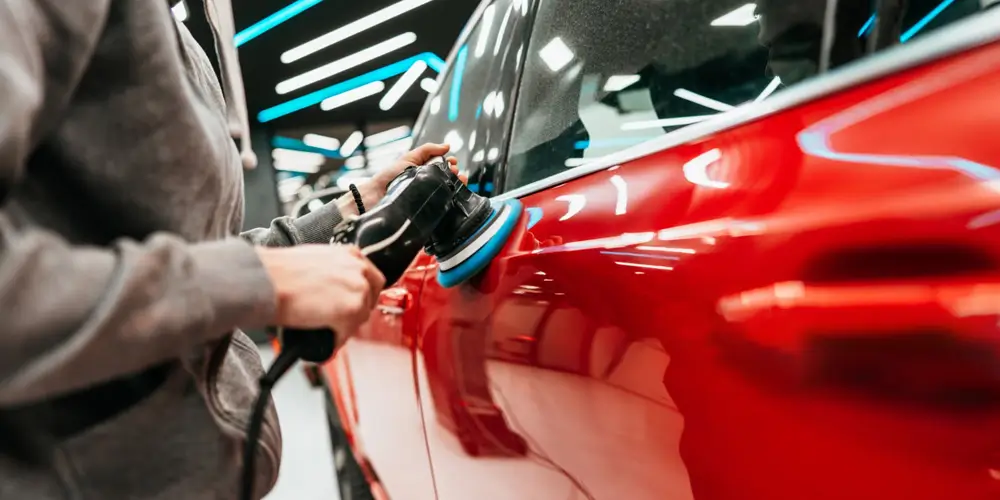
5. Machine technique and environment: control speed and pressure; heat buildup damages clear coats. Use a dual-action polisher for safer, repeatable results; rotary machines are faster but riskier. Work in shaded, dust-free areas and inspect frequently.
6. Clean and protect: always remove abrasive residues fully with appropriate cleaners and finish with a paint protection layer (sealant or wax). This stabilizes optics and reduces recurrence of marring.
Selecting pads and tools
Pad selection influences cut level and finish. Use firm, densely cell-structured pads for compounds, medium-density pads for medium polishes, and soft finishing pads for final polish. Microfiber pads can accelerate cut but require more skill. When in doubt, err on the side of a softer pad and multiple light passes.
SYBON — Professional polishing compounds you can rely on
SYBON is a China-based professional manufacturer and distributor of polishing compounds and complementary automotive care products. Our formulations are engineered for consistent abrasive performance, predictable cut rates, and reliable finishes across modern clear coats and paint systems.
Why SYBON?
• Comparable quality to major international brands: SYBON products are manufactured according to strict production and inspection standards, delivering correction performance and final gloss that stand alongside well-known market leaders.
• Better value and competitive pricing: while SYBON may not carry the same brand recognition, our pricing structure is designed to offer significantly improved cost-effectiveness—allowing auto repair shops, dealerships, and distributors to maintain margin and compete locally.
• Full product range for staged correction: SYBON provides heavy-cut compounds, medium polishes, and finishing polishes optimized to be used in sequence—ensuring predictable removal of sanding marks and excellent final appearance.
• Customer-focused service: we support our distributors and end-users with product information, usage guidelines, and after-sales assistance. SYBON welcomes agents and distributors globally and offers sampling opportunities for evaluation.
• Wholesale and distribution support: if you want to buy polishing compound in bulk for resale or fleet servicing, SYBON provides competitive wholesale pricing and distribution partnerships to help you grow your automotive care business.
Partnering and samples
SYBON actively seeks global agents, distributors, bodyshop partners, and resellers. If you operate a paint shop, auto repair center, or distribution business and would like to evaluate our products, request samples through our website. We are committed to timely responses and will contact interested parties within 24 hours to discuss technical specifications, pricing, minimum order quantities, and marketing support.
Conclusion
Deciding between a compound and a polish to remove sanding marks comes down to the severity of the scratches and the amount of material you are willing to remove. Compounds provide aggressive cut for pronounced sanding marks; polishes refine and restore gloss for lighter marks or after compounding. Deploying a staged approach—assessing defects, matching abrasives, using proper pads and machines, and finishing with a suitable polish and protection—delivers the fastest, safest, and most predictable results.
When you need professional-grade compounds and polishes that balance performance and price, SYBON offers a compelling alternative to big-name suppliers. For wholesale inquiries, product samples, or distribution opportunities, contact SYBON via our website email and our team will reply within 24 hours. Choose SYBON for high-quality polishing solutions that help you remove sanding marks efficiently and grow your business profitably.
Source of this article:https://www.sybonbest.com
Get to know us through more channels: